

Get your daily news on finance and banking
Provided by AGP
Direct carrier billing market seen topping $103 billion by 2030
May 3, 2026
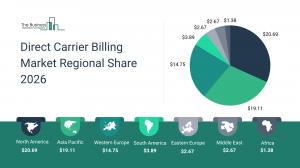
By AI, Created 9:42 AM UTC, May 20, 2026, /AGP/ – A new Business Research Company report projects the global direct carrier billing market will grow at a 12% CAGR through 2030 and surpass $103 billion. North America is expected to lead the market, while the limited direct carrier billing segment remains the biggest category.
Why it matters: - Direct carrier billing is becoming a bigger part of mobile commerce as consumers look for payment options that do not require credit or debit cards. - The market’s growth points to stronger demand for in-app purchases, digital subscriptions and telecom-enabled payments. - The report also signals where revenue is likely to concentrate: North America, the USA and limited direct carrier billing.
What happened: - The Business Research Company released a forecast saying the global direct carrier billing market will grow at an expected 12% CAGR through 2030. - The market is projected to surpass $103 billion by 2030. - The report pegs the broader Digital Technology parent market at about $4,842 billion by 2030. - Direct carrier billing is expected to represent around 2% of that parent market. - Within the broader Information Technology industry, estimated at $13,807 billion by 2030, direct carrier billing is projected to account for nearly 0.7%. - Request a free sample of the report - Access the detailed market report
The details: - North America is forecast to be the largest region in 2030, valued at $33 billion. - North America’s direct carrier billing market is projected to rise from $19 billion in 2025 at a 12% CAGR. - The USA is expected to be the largest country in the market in 2030, valued at $28 billion. - The USA market is projected to grow from $16 billion in 2025 at a 12% CAGR. - The largest type segment in 2030 is expected to be limited direct carrier billing, which should account for 56% of the market, or $58 billion. - The market is also segmented by authentication type into single factor authentication and two factor authentication. - The market is segmented by end user into application and games, online media and other end users. - Limited direct carrier billing is supported by app store purchases, digital subscriptions, lower transaction risk than pure DCB, stronger operator control over billing limits and integration with mobile ecosystems.
Between the lines: - The forecast reflects a broader shift toward mobile-first payments, especially for digital content and subscription services. - Carrier billing is gaining traction in markets where many users are unbanked, underbanked or have low credit card penetration. - The report’s growth assumptions also depend on rising smartphone access, faster mobile internet and deeper telecom integration with app stores and OTT platforms. - The report says the biggest growth drivers are rising smartphone and internet penetration, growing demand for digital content and in-app purchases, and financial inclusion. - Rising smartphone and internet penetration is projected to add about 2.8% annual growth. - Growing demand for digital content and in-app purchases is projected to add about 2.5% annual growth. - Financial inclusion and low credit card penetration is projected to add about 2.3% annual growth. - The report says the largest growth opportunities over the next five years are in limited DCB, pure DCB, MSISDN forwarding and other types. - Those segments are projected to add more than $44 billion in market value by 2030.
What’s next: - Limited direct carrier billing is projected to grow by $24 billion from 2025 to 2030. - Pure direct carrier billing is projected to grow by $14 billion over the same period. - MSISDN forwarding is projected to grow by $4 billion. - Other types are projected to grow by $2 billion. - The Business Research Company says its reports use primary and secondary sources, along with interviews and datasets, and includes a disclaimer that its findings are estimates and opinions rather than investment guidance.
The bottom line: - Direct carrier billing is moving from niche payment rail to a mainstream mobile-commerce tool, with the strongest growth expected in North America and on app-driven subscription spending.
Disclaimer: This article was produced by AGP Wire with the assistance of artificial intelligence based on original source content and has been refined to improve clarity, structure, and readability. This content is provided on an “as is” basis. While care has been taken in its preparation, it may contain inaccuracies or omissions, and readers should consult the original source and independently verify key information where appropriate. This content is for informational purposes only and does not constitute legal, financial, investment, or other professional advice.
Sign up for:
Money, Banking & Me
The daily local news briefing you can trust. Every day. Subscribe now.
Check Your Email!
We sent a one-time activation link to: .
Confirm it's you by clicking the email link.
If the email is not in your inbox, check spam or try again.
Welcome back!
is already signed up. Check your inbox for updates.